
9 Best Luxury Yacht Website Examples That Convert High-End Buyers
Does your luxury yacht website reflect the quality of the yachts you are selling?
Speaking of luxury yachts, a few names immediately came to mind – Fraser, Burgess, Feadship, Princess. Their yacht websites look ritzy. Is that really what attracts their high-end clients?
What makes the best luxury yacht websites highly converting and so difficult to replicate? Is there a template?We don’t think so.
What separates a site that generates a lot of enquiries from one that simply exists? Do you ever wonder whether your website is working for your brand or quietly working against it? You will find that out right now.
Ultra-high-net-worth individuals do not browse yacht websites the way an average customer shops online.
They judge the competency of a company with the imagery, typography, and the fluency of the experience that they use on their websites. And that judgement is shaped by the traits that define whether a brand is truly positioned as luxury.
This article studies the best luxury yacht websites, examining exactly what each one does to earn that trust of serious buyers and charter clients.
If your current website is not generating the quality of enquiries that these websites are, we will make it clear what to do about it.
9 Luxury Yacht Website Examples
The number of ultra-high-net-worth individuals is rising globally. And as per their lifestyle demands, they want to invest in luxury yachts. This is why the market is projected to grow from USD 10.14 billion in 2025 to USD 19.04 billion by 2034.
More UHNWIs means more clients looking for luxury yachts. And, in such a competitive market, your business needs a website that monopolises on this. Start working with an expert in luxury yacht web design. It’s a smart business move and will help you be noticed by millions of luxury consumers who live online.
We have curated this list of 9 of the best luxury yacht website designs according to visual communication, UX/UI strategy, search functionality, and calls-to-action strategies proven to convert UHNWIs in this market with a continuous upward growth.
1. Fraser Yachts
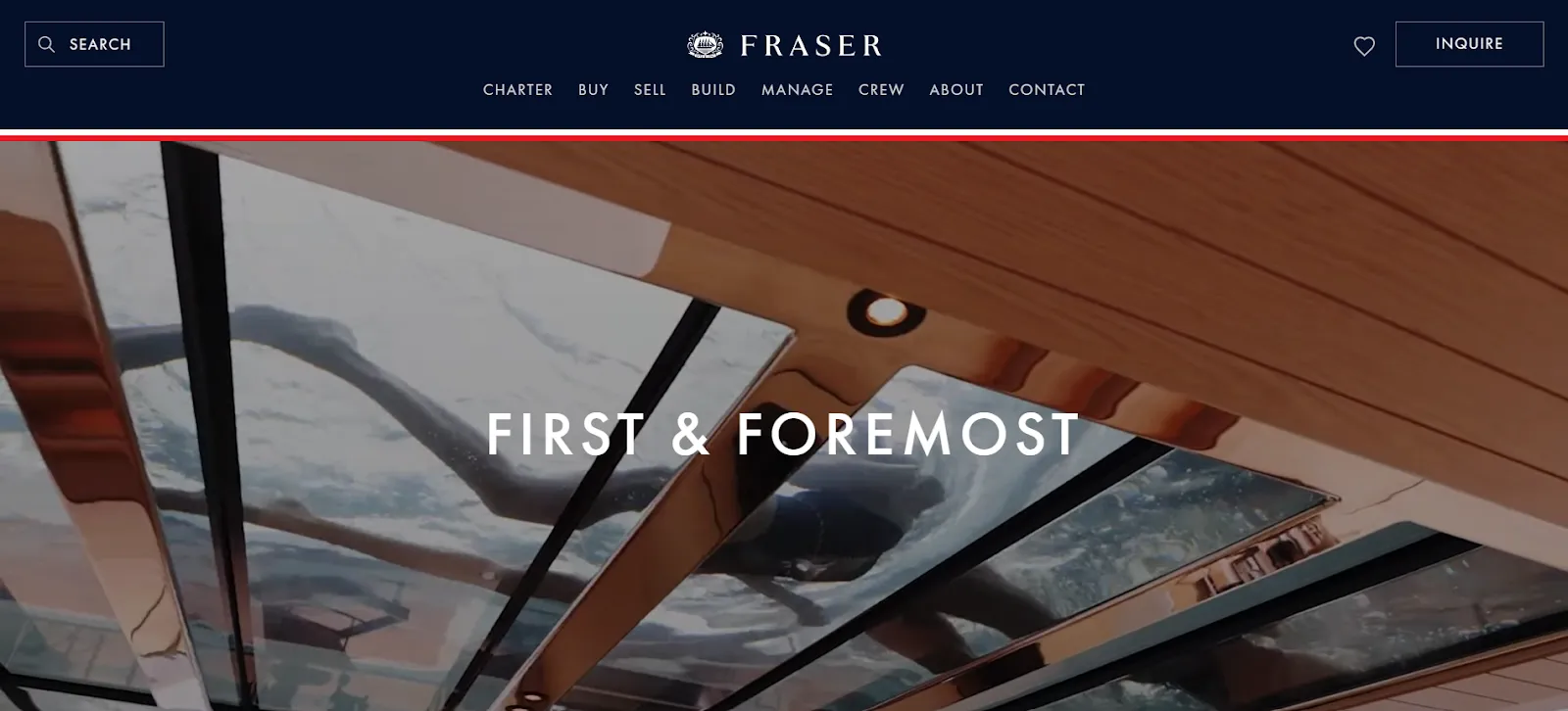
Fraser Yachts has maintained its prestige in the global luxury yacht market for over seven decades. And they have a website that mirrors that same sophistication. Most extraordinary is their homepage, an immersive hero image presented as a full-screen, high-quality slideshow of their luxurious concierge, their five-star services, and the ultra-high-net-worth clientele that frequently charter with them.
What particularly caught our eye from a commercial perspective is how the vessel listings are structured. The yacht search functionality makes it super easy for a prospective client to filter the superyachts by charter and sale, providing crucial information upfront, like the price, vessel size, and availability, and pulling live inventory through a YATCO feed. This is a genius detail that ultra-high-net-worth clientele love, because it feels like an online concierge is answering their every question.
A serious buyer or charter client can access superyachts’ specifications, choose yachts for charter, make an investment, or get advice from expert charter brokers. The kind of content and structure this website has quickly moves a visitor from interested to the enquiring stage.
2. Burgess Yachts
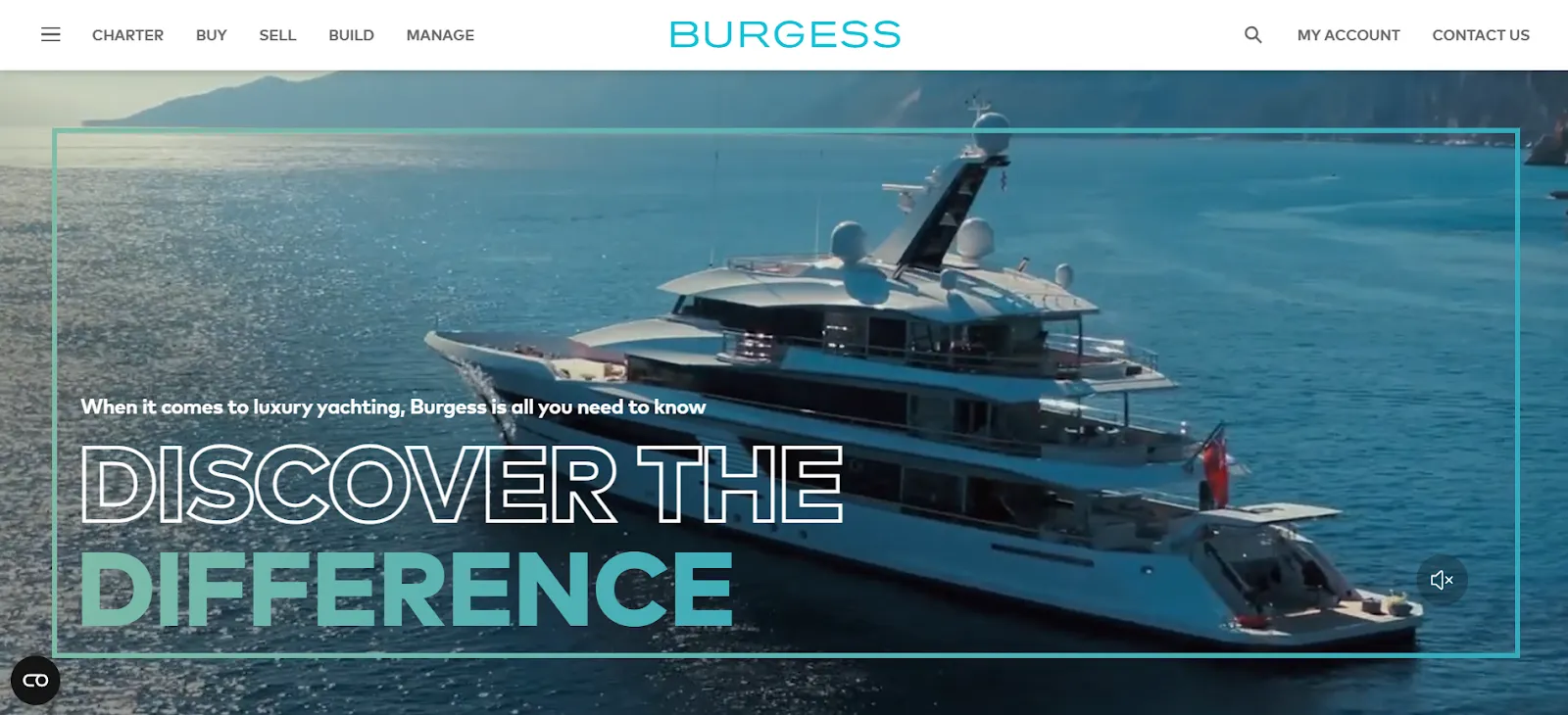
Burgess has a darker colour palette as compared to Fraser. The first half of the homepage features white typography against a dark background, which imparts an editorial, trustworthy aura to the website. Burgess is one of the authoritative voices in the luxury yacht industry.
One of the most distinct features of the website are the separate blocks that divide brokerage, charter, destinations, and news and editorial sections covering the major luxury events your clients are attending, such as the Palm Beach International Boat Show. Such reports and insights build trust with high-net-worth clients who want to work with a company that can support their financial decisions.
When you scroll down, the visual hierarchy and consistency in brand messaging and offerings sends a clear signal to a prospective client that they are engaging with a team that is serious about its work. There is promotion without over-advertising and urgency CTAs, letting the fleet of Burgess speak for itself.
3. Princess Yachts
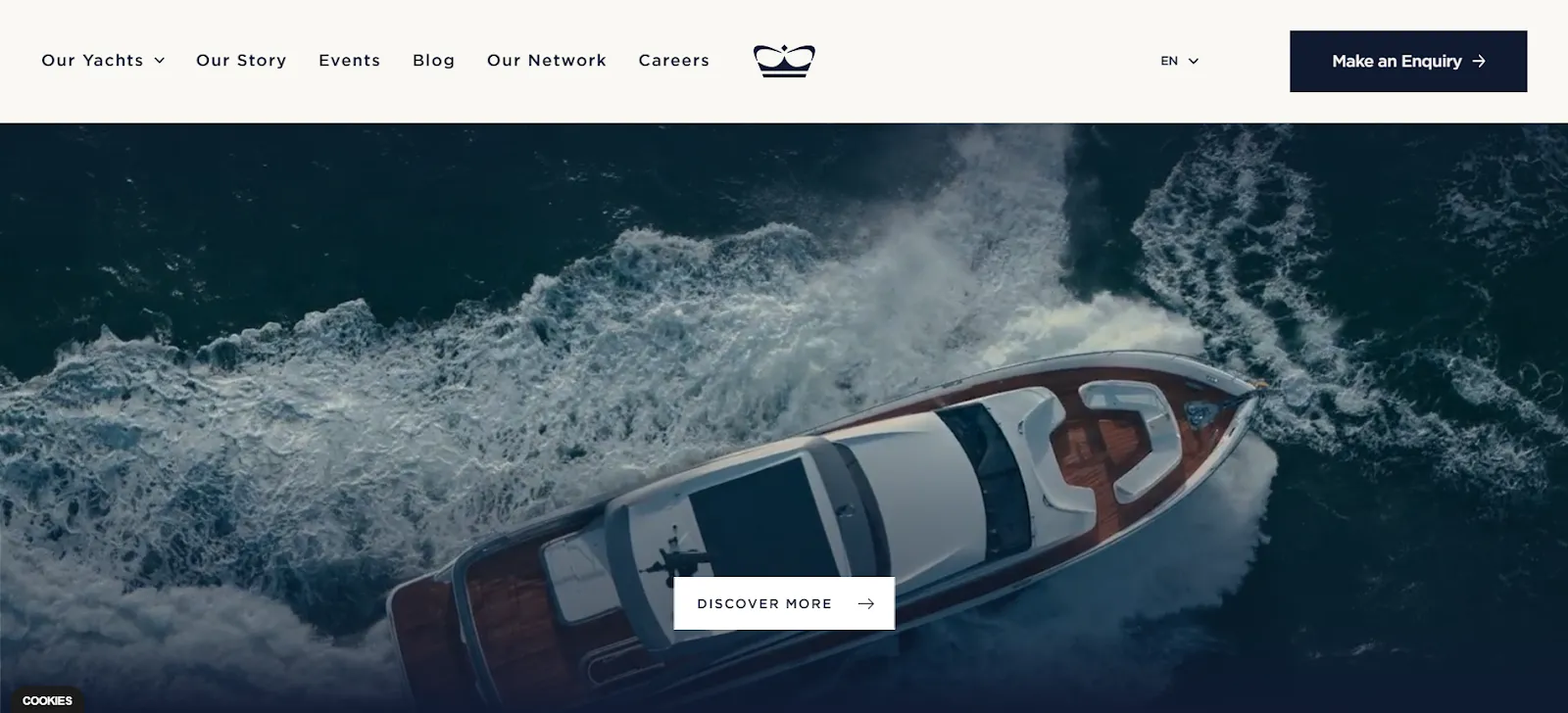
Princess Yachts has one of the most cinematically aesthetic luxury yacht websites. The reason why this one sticks in your mind when looking for web designs in the production yacht segment is that the hero section video tells a dramatic story behind the birth of this brand.
The video runs as the primary communication medium between the brand and customer. It tells the story of how Princess Yachts are born in unpredictable conditions of the North Atlantic waters. And for each model range, this single video stands as a testament, as a prospective owner will never question its capability while seeing a Princess yacht cut across open water at exhilarating speeds. No specification sheet could deliver a more powerful promotion.
A yacht brand owner must understand that the way your vessels are shown on your website directly affects how seriously potential buyers take your brand, and whether or not they will move on to the enquiry stage. A high-quality production video by Princess sets a benchmark that matches high-end automotive and aviation brands, creating desire even before it states specifications, which is the correct sequence for a potential luxury purchase.
4. Sunseeker International
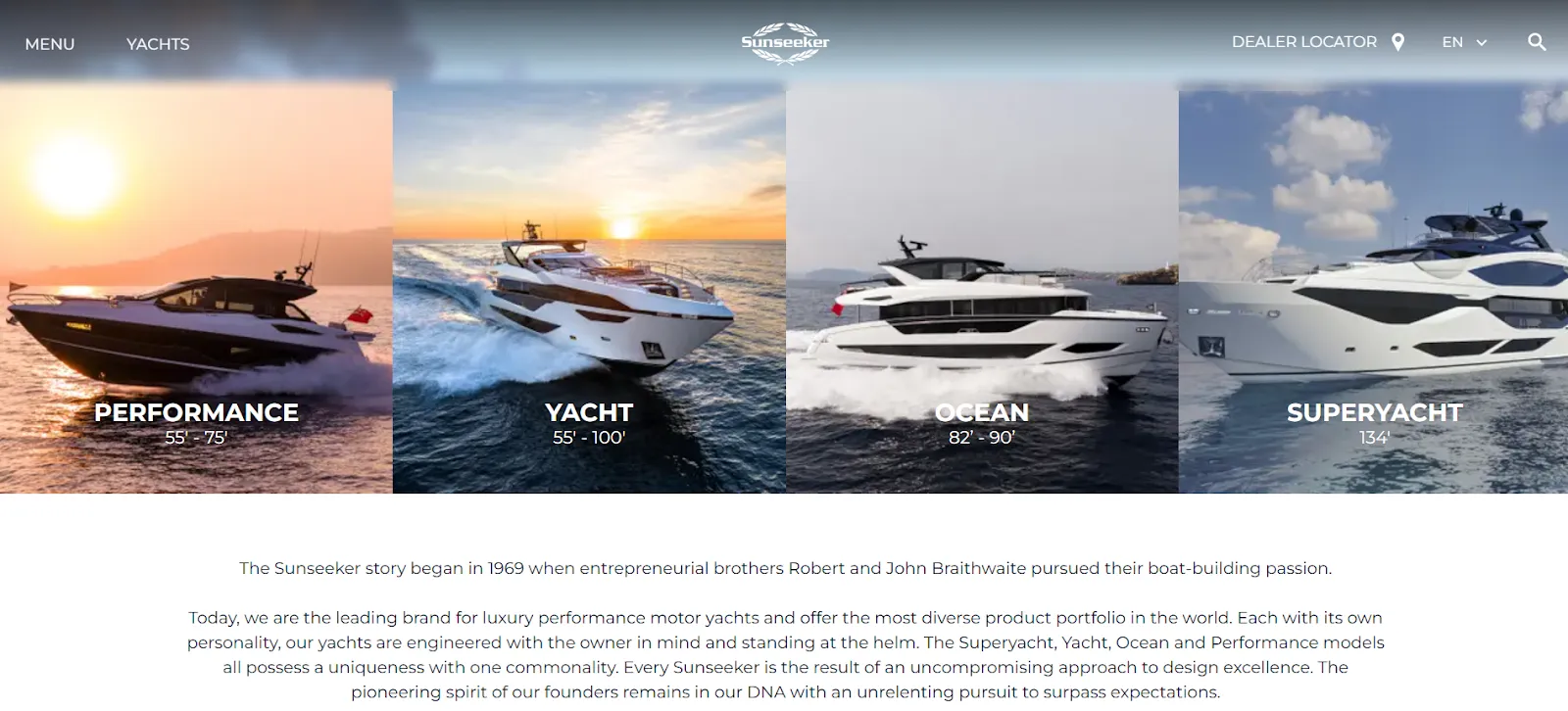
Sunseeker presents its model range in a rather unique manner. They have created four distinct sections on their website, categorising yachts from 55 to 134 feet. When you click on a range, it expands into another menu on the same page that presents yachts within that size category.
Such an easy distinction between your own products captures an international audience, because you might not always know the varying levels of product knowledge they have. By categorising its fleet, Sunseeker has also created a clutter-free website, without compromising on its brand’s premium positioning.
Sunseeker achieves this through a modular website design. Each model range on its website has its own dedicated landing space – individual in content and photography. A client exploring a 75-foot sport yacht and a client following a 134-foot superyacht are both on the same webpage.
The editorial section is also embedded in the site, which keeps the brand storytelling constant throughout.
5. Mangusta

Mangusta promotes its performance yachts on its website in a way that attracts clients with a passion for speed and engineering. Their website opens with a dramatic shot of their newest yacht model, which leaves no ambiguity about what kind of brand Mangusta is.
This clarity is commercially valuable for the brand because it qualifies its visitors before they move onto the enquiry stage. Clients who are into performance-focused brands will immediately engage with this yacht brand’s website.
A yacht brand owner can learn one important thing from Mangusta’s website; luxury customers love a balance between emotional communication and technical knowledge. The specifications, naval architecture data, and other details are all present thoroughly, but Mangusta’s clients are attracted to the real photographs of the yachts on water and their production sites spanning across 210,000 square metres in Tuscany.
The lesson learned is that ultra-high-net-worth clients are intelligent people. And since they are making large investments, they will always respond to intelligent websites that will never sacrifice information for aesthetics.
6. Feadship
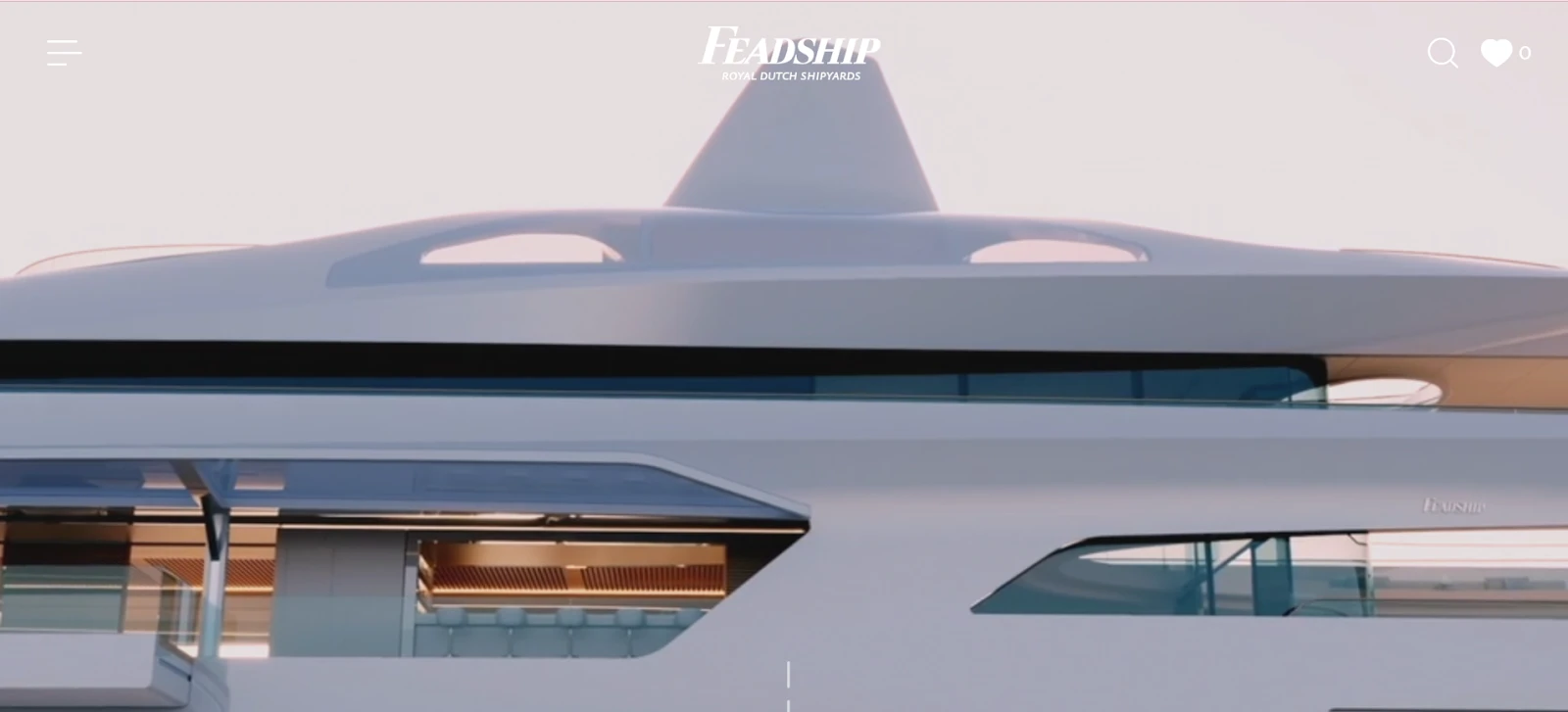
Feadship confidently begins its homepage with the words ‘There are yachts, and there are Feadships.’ It portrays the brand’s exclusive position in the superyacht market.
Feadship’s website has no aggressive calls to action. Its UI is minimalist, but not boring, because a boring design cannot coerce the target client, that is why Feadship reassures that its concept designs are genuinely exceptional. This type of reassurance is very important for new yacht businesses as it genuinely builds a luxury brand from the ground up.
For brand owners in any tier of the yacht market, Feadship’s website design is a great example. Its structure is not a generic conversion funnel. For yacht clients at the very top of the market, Feadship provides evidence of its authority with market updates, latest launches, and featured videos.
The photography on the Feadship yachting website is also among the finest on any yachting website in this list.
7. Benetti
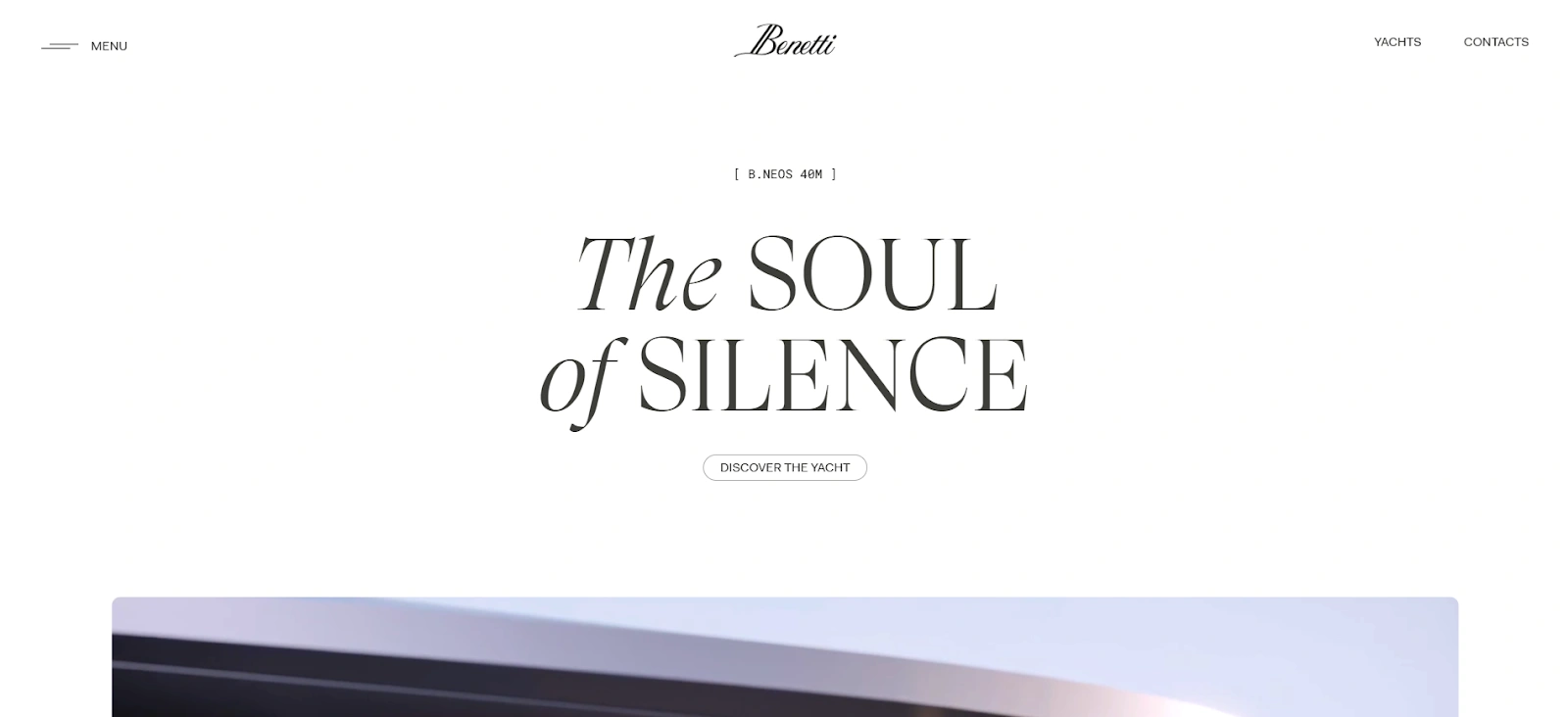
Benetti is the world’s oldest luxury yacht company, in operation since 1873. But their website says something else. It still carries that air of heritage, but it is pronounced via modern elements.
One of the most prominent features of this yacht website is its luxury typography. After which, a scroll-triggered animation which zooms in on a close-up of a yacht catches the eye. Everything is intentionally Italian and premium, even though the layout itself is entirely contemporary. For a brand owner managing a heritage brand, the Benetti site is a useful study in how heritage brands can modernise without losing their identity.
The website uses parallax scrolling to showcase each new build on the Benetti site. Clients commissioning a vessel above 40 metres are confidently assured that the builder’s process and final product are world-class. An interactive navigation menu further adds to the confidence. It links all the yacht models, presented by their respective miniature drawings.
8. Heesen Yachts
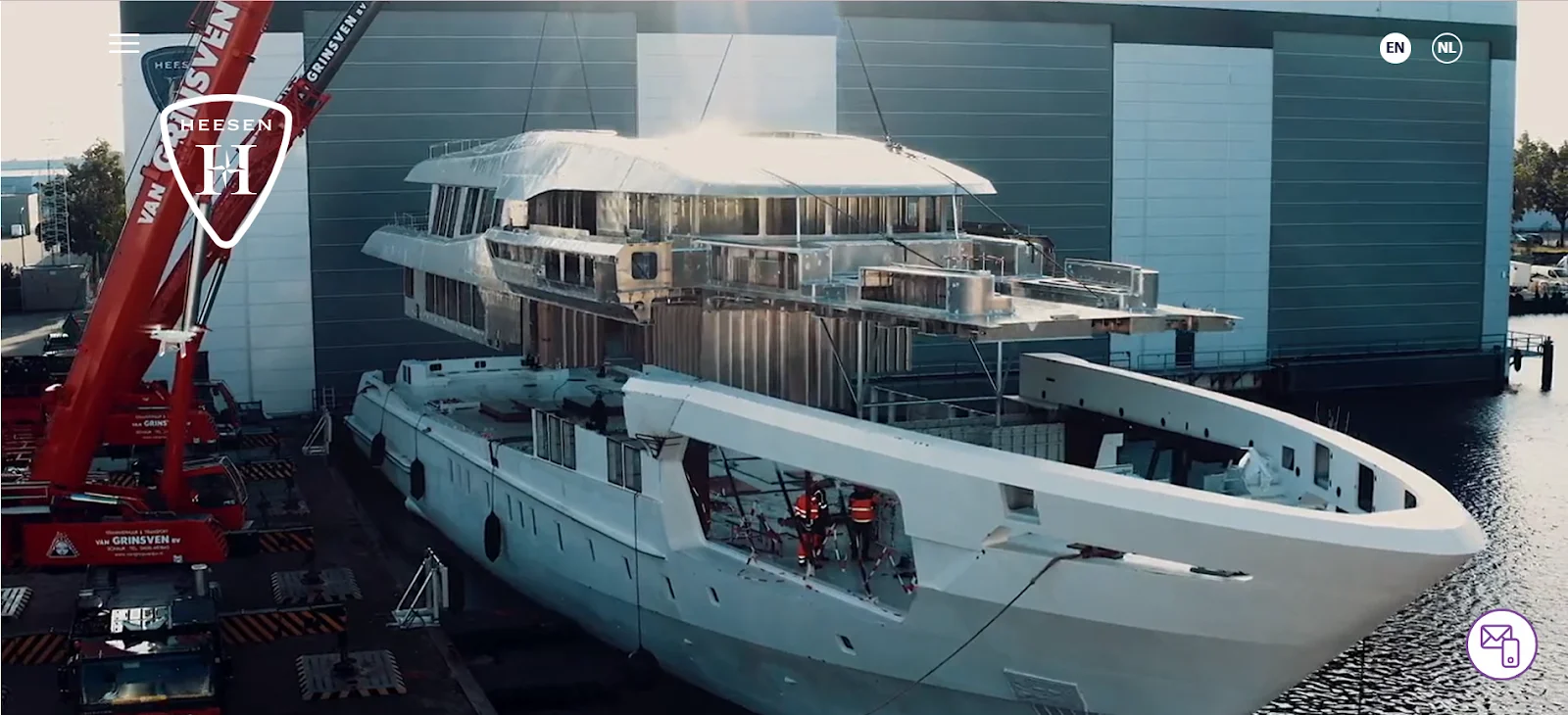
Heesen has built its yachting website around a three-tier ownership model – Series, Smart Custom, and Full Custom.
However, rather than letting an owner decide what to buy through a flat product catalogue, the site has created a customer-focused framework. It asks you how much customisation you want, and how soon do you want delivery. Further elaboration is done when a client clicks on a category to know more about it, and Heesen provides a list of projects they have completed in the past.
The ‘available yachts for sale’ section is very noticeable. The listings explicitly detail delivery timelines, hull type, speed, tonnage, exterior and interior designer credits, and guest capacity. The BlueNautech section showcases Heesen’s sustainability programme, a message that carries immense weight within UHNW clients’ circles who face scrutiny over their environmental footprint.
9. AB Yachts
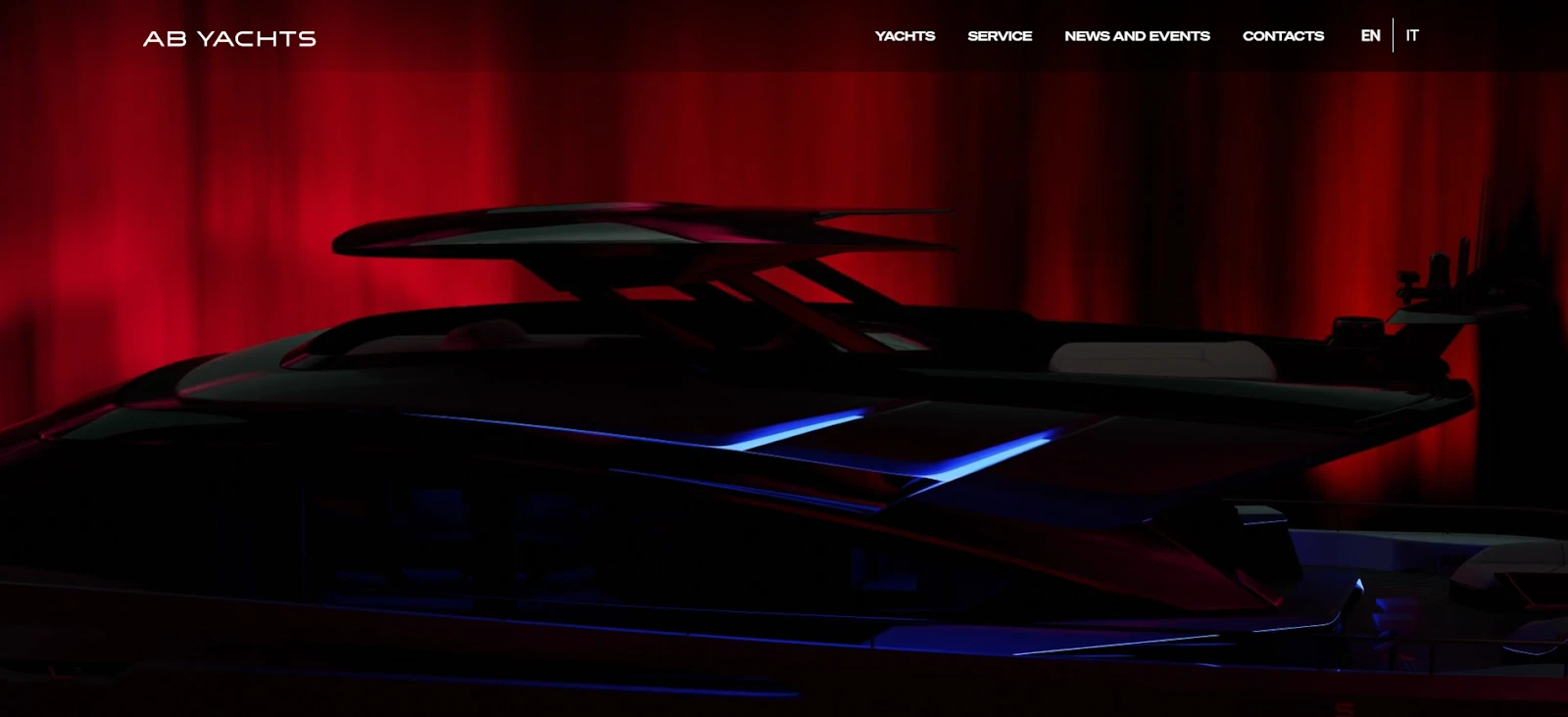
AB Yachts makes no attempt to appeal to all buyers. Its brand positioning, built around performance, speed, and Italian engineering, makes it very clear that this yacht website will only cater to a specific group of UHNWIs.
The model range runs from the AB 80 through to the AB 130. When you click on them, each vessel page begins with a dramatic video that shows life on the luxury yacht. Then, it first discusses the most attractive features of the vessels, such as a ready-to-enjoy beach area and sundeck, proceeds to an HD gallery to increase consumer desires, and finalises with technical data and layout before asking the visitor to ‘fill out the form’ as the final CTA.
The news section is actively managed, covering boat show appearances at Cannes, Monaco, Dubai, Palm Beach, and Venice, along with launch announcements and the recent unveiling of an AI-integrated onboard assistant system. This is a great case study for a luxury yacht brand owner. It shows how to use a website’s editorial section to demonstrate your market presence.
It is important to look at these luxury yacht website designs and understand where your own digital presence lies. Let’s take a quick look at their design features once again.
| Brand | Strengths | Major Strategies | Design Features |
|---|---|---|---|
| Fraser Yachts | Immersive homepage | Advanced search and filtering | Full-screen slideshow |
| Burgess Yachts | Editorial authority | Content segmentation | Dark palette |
| Princess Yachts | Cinematic storytelling | Unforgettable storyline | Hero video |
| Sunseeker | Clear categorisation | Modular structure | Expandable menu |
| Mangusta | Performance features | Emotional branding | Dramatic visuals |
| Feadship | Exclusive positioning | Authority signalling | Minimalist UI |
| Benetti | Heritage and identity | Modern storytelling | Parallax scrolling |
| Heesen Yachts | Client framework | Guided selection | Structured listings |
| AB Yachts | Niche targeting | Lifestyle positioning | HD videos |
If you recognise the warning signs that your site is already overdue for a rebuild, it is worth speaking to Global Bay, our award-winning luxury digital agency, for we have spent over a decade fixing exactly these problems for luxury brands. You can entrust your websites to us.
What Are the Best Design Features of Luxury Yacht Websites?
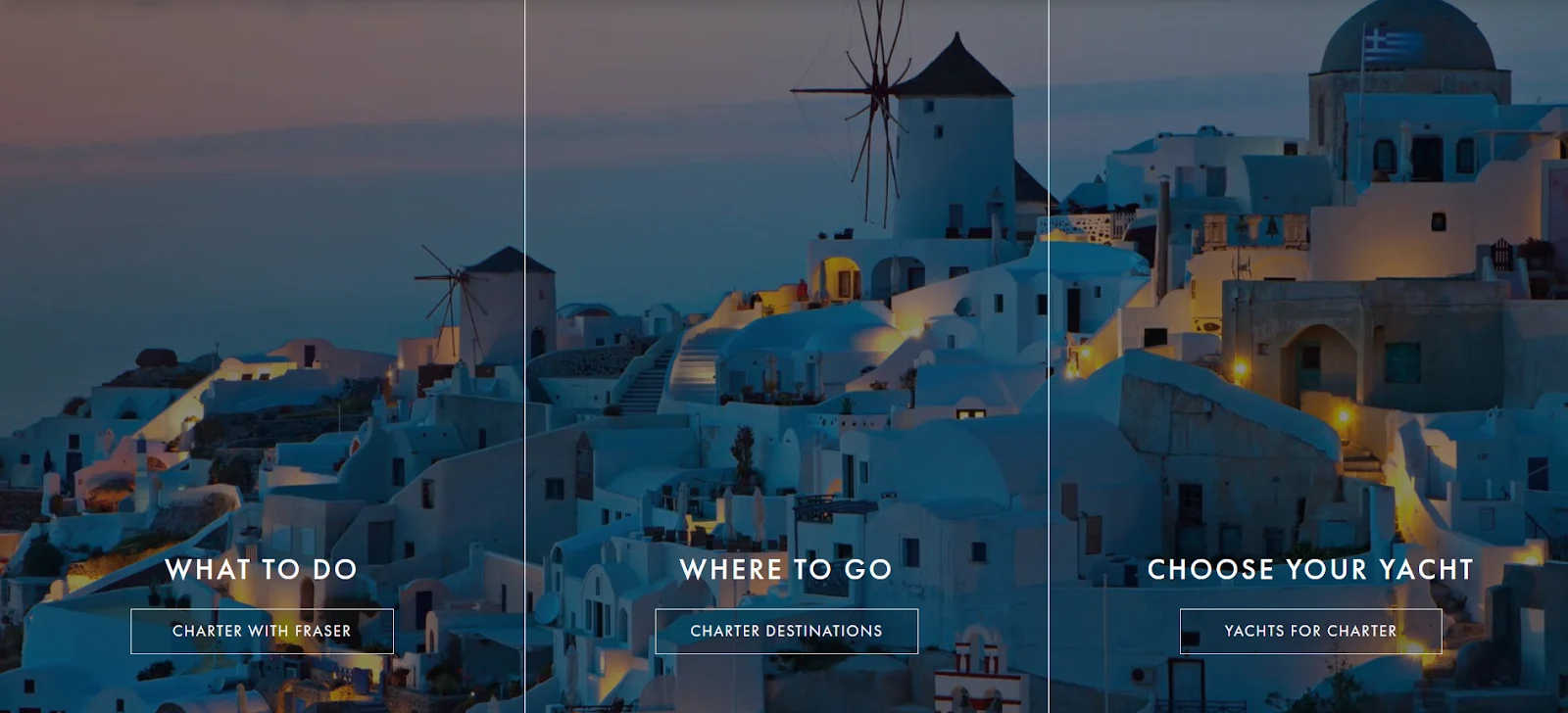
While looking at the luxury yachting websites that are acquiring UHNW clients in 2026, such as Fraser, Burgess, Feadship, Heesen, and Princess Yachts, a very clear picture emerges. Every high-performing luxury yacht website has a sophisticated identity, cinematic videography, and a strong commercial aspect, but there are some other design features that every luxury yacht website must have.
1. Rich Visual Communication:
Every high-performing luxury yacht website has high-resolution imagery, and Fraser’s current site is a direct example of it. The brand shifted away from basic navigation and limited visual evidence and created an unforgettable identity that aligns with the luxury market it serves. Princess Yachts also uses a cinematic video as the primary means of communication between its clients and every model range.
2. Sticky navigation and intuitive menu:
The best luxury yacht website design idea is to keep navigation fixed as your visitor scrolls. Another take from all the genius websites we have discussed is to separate your sales, charter, management, new construction, and crew services into different sections. Burgess Yachts’ client will know exactly where to find brokerage, charter, new build, and management details. This is why the user experience plays an important role in the commercial result of a brand.
3. Advanced search and specialist listing pages:
4. Detailed yacht listings:
5. Expanded content that completes client journey:
Burgess presents market reports and destination analysis on its website. Benetti will showcase each of its new builds as a standalone editorial feature, complete with photography and designer interviews. Heesen gives as much attention to yard heritage as it does to current vessels, which brings organic search visibility to the site.
6. Interactive tools:
Interactive tools on luxury yacht websites, such as an itinerary builder, can generate a personalised specification. Furthermore, virtual tours can also improve the browsing experience. Visitors will be more interested in making enquiries because if they have taken time out to configure their ideal vessel, it means that they are a serious prospect.
7. A strong brand identity:
The most distinctive luxury yacht website designs have the most distinctive identities. They make no concessions about who they are speaking to. Most of these websites will carry no pricing tools, no booking forms, and no CTAs, because they know that their client does not respond to those things. However, they would present their model ranges on dedicated landing pages, because, like we already mentioned, they make no concessions to anyone other than the UHNWIs.
8. CRM integration:
Live chat, direct contact pathways, and other features that enable a client to talk to you at the right time make all the difference in luxury yacht websites. You must incorporate direct contact options contextually throughout the website, so that they are accessible when the client wants them, and unobtrusive otherwise.
9. Search engine optimisation:
Luxury yachting websites must secure top search engine positions, especially for competitive global maritime terms. When SEO is built into a website, it loads faster, has optimised content, and has overall better technical health. All targeted landing pages must contribute to the visibility of the website.
5 Mistakes in Luxury Yacht Websites That Make A Negative Impression On UHNWIs
Luxury yacht websites sometimes do not meet the expectations of ultra-high-net-worth individuals (UHNWIs). A high-performing luxury yacht website must always be aesthetic, but also have exceptional technical features. Here are the most common mistakes seen across luxury yacht websites.
1. Confusing Navigation:
2. Slow Website Performance:
Many luxury yachting websites rely on HD images and videos, which leads to slow loading times. This creates friction at the beginning of user experience. A slow website is inefficient and damages trust in a high-value industry.
3. Lack of Mobile Optimisation:
Luxury clients are mobile. They are always travelling or moving, and if luxury yacht websites want to reach them, they must not have a poor mobile experience. A lack of responsiveness and misaligned layouts diminish brand image, both from an SEO and user experience perspective.
4. Poor Readability:
Surprisingly, a common mistake in luxury yacht website designs is that the content isn’t easily visible. Low contrast colour schemes and small text sizes make it very hard for users to understand your business.
5. Weak SEO and Search Visibility:
Many luxury yacht websites ignore content optimisation, which is why they fail to rank for key industry terms. UHNW individuals rely on search engines, as well as large language models such as GPT, Gemini, and Claude to explore their options. Without search engine visibility and authoritative content that appear in AI-generated recommendations, they cannot find your premium products.
How Global Bay Transforms Yacht Brand Websites
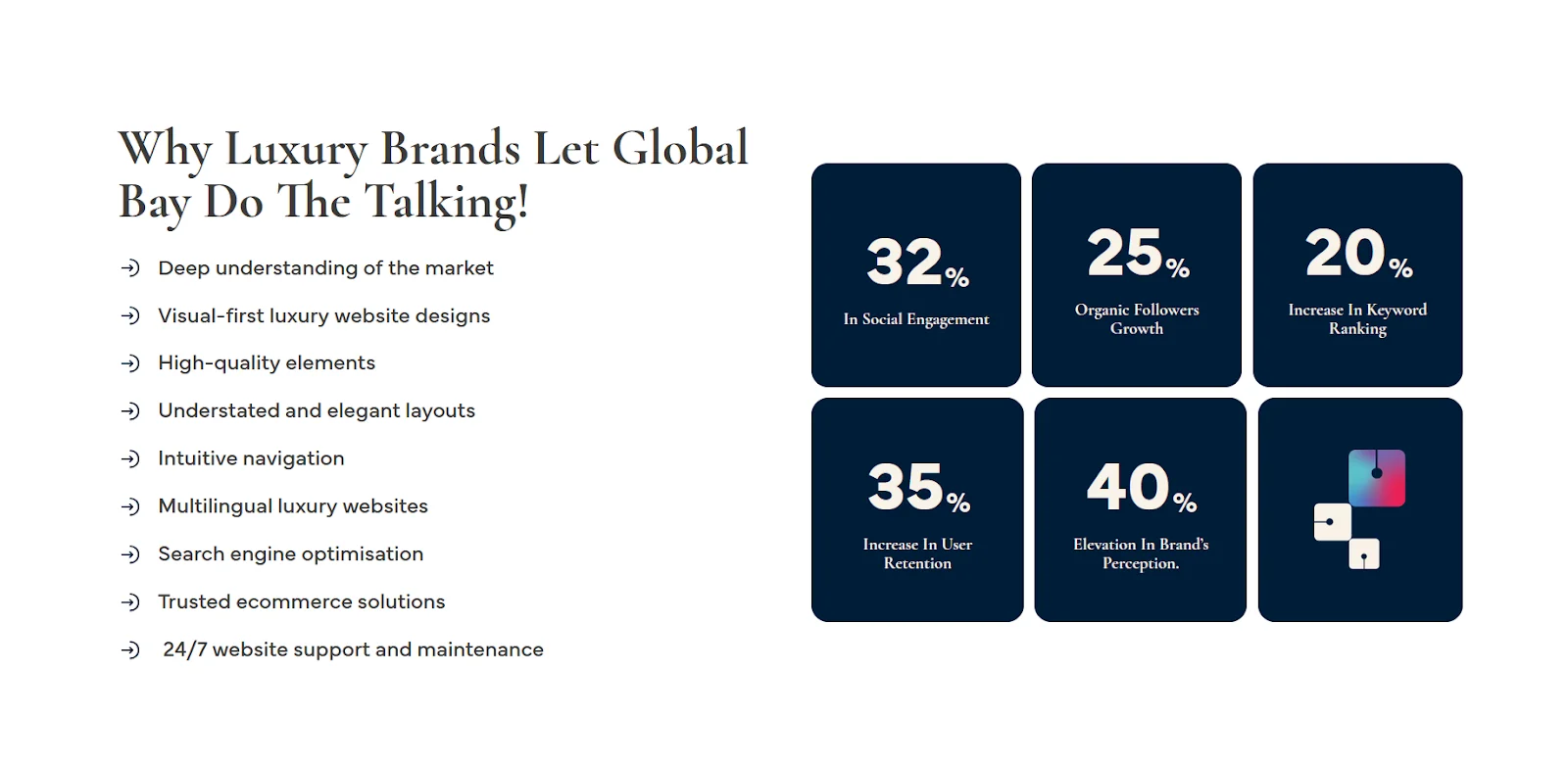
Did the luxury yacht websites discussed above set these high digital standards by accident?
No. They collaborated with web designers and developers who knew how to create high-performance websites. To align with the reality of the ultra-luxury market, generic web production must go, and sensible web designs must come into view.
This is exactly where Global Bay comes in.
Global Bay has been helping brands with premium digital experiences for over a decade. Our agency has been recognised as a finalist at the Bristol Life Awards in both 2025 and 2026. We also bagged the Lux Life Magazine ‘Leaders in Luxury Awards 2026’ and the Corporate Vision Small Business Award for Best Luxury Digital Design Services in the UK in 2025.
Our work process with a luxury yacht brand starts with a rigorous audit of its current website. Then we compare it against the leaders in the same category, after which, a strategy takes shape that plans how to address charter bookings, live inventory integration, brokerage operations, and CRM management.
So, if your website is weakening the brand presentation of your yacht company, book a conversation with Jon Basker, director of Global Bay, to find out exactly what needs to change.